Experiment about relationship between magnetic repulsive force and flux density.
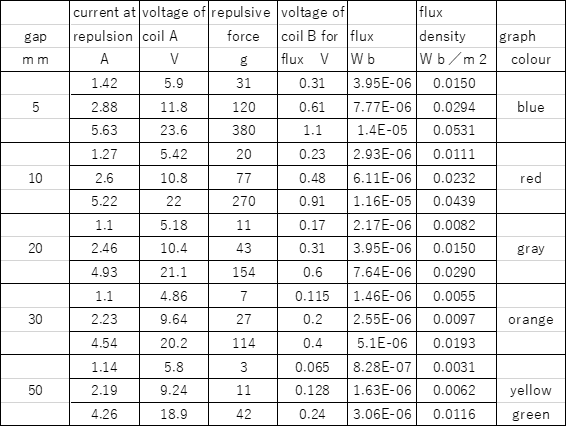
1.Experimental result of repulsive force and flux density
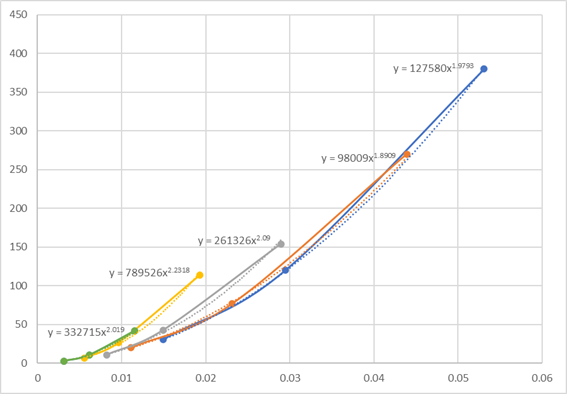
X-Axis : flux density (Wb/m2) Y-Axis : repulsive force (g)
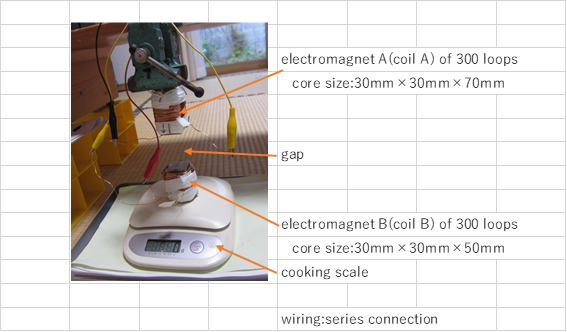
2.method of experiment
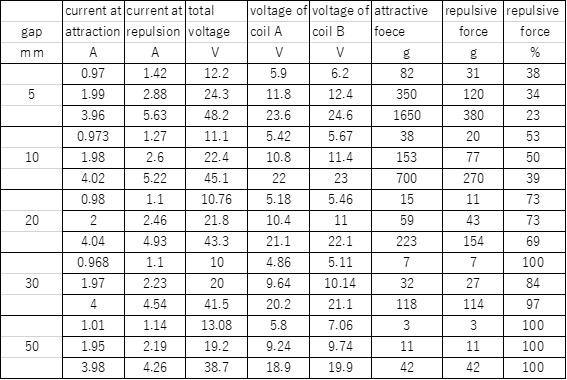
2-1.The measurement of repulsive force and attractive force.
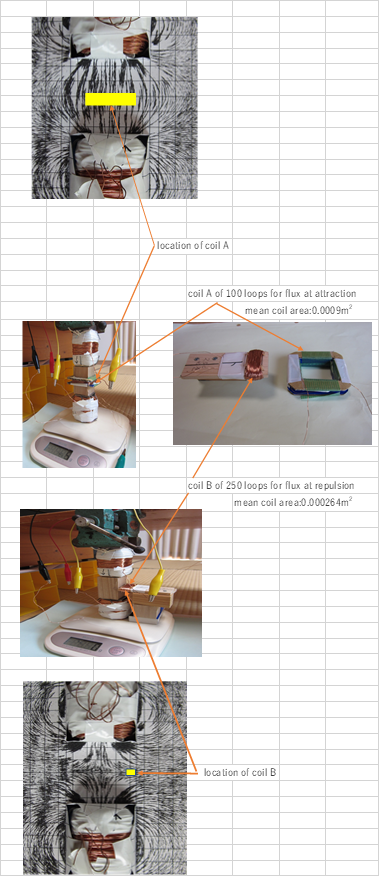
2-2.The method of measurment of flux
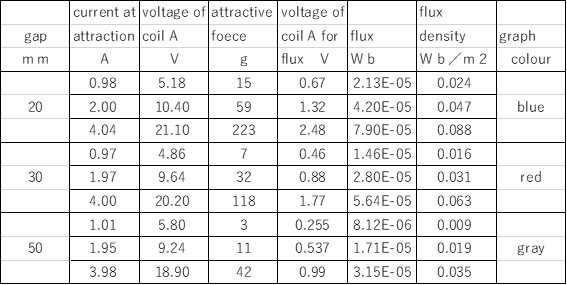
3.Experimental result of attractive force and flux density
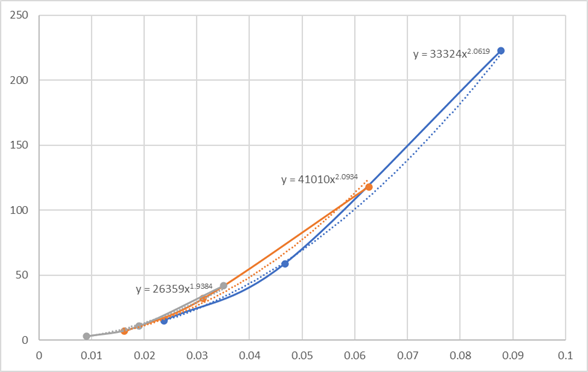
X-Axis : flux density (Wb/m2) Y-Axis :attractive force (g)
4.Comparison between repulsive force and attractive force
4-1.Electromagnet
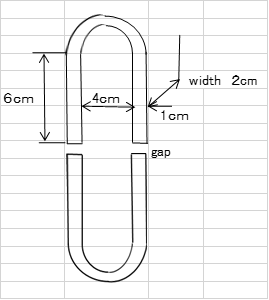
4-2.U -shaped magnet
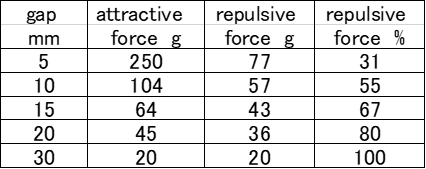
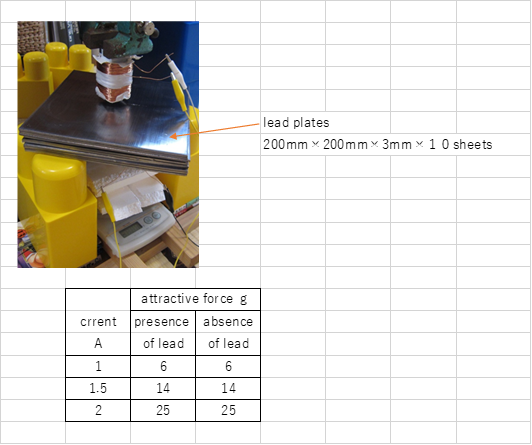
5. Difference of electromagnetic force by presence or absence of lead
6.Experiment about relationship between transmission rate of magnetic field and relative permeability of core of electromagnet, on the two electromagnet. It is addition in July, 2022.
The experimental result say that the transmission rate of magnetic field is influenced by magnetic flux B which is made by the magnetic field .
6-1 Method of experiment
・Layout of the electromagnet A and electromagnet B

・Specification of electromagnets

*1 electromagnet A : 2.34Ω electromagnet B : 2.31Ω
OD: outer diameter
ID: inner diameter
TH: thickness
MT: material
ERP: estimated relative permeability
WN: winding number
R: resistance
・Wiring when only the electromagnet A is connected

IC : input current
av : the voltage to work to the electromagnet A
acv : the voltage that is induced to the electromagnet A
acv=(av2―(IC×Ra)2)0.5
Ra : the resistance of the electromagnet A
bcv : the voltage that is induced to the electromagnet B
haa : the magnetic field by the electromagnet A, at the electromagnet A
hab : the magnetic field by the electromagnet A ,at the electromagnet B
・Wiring when the two electromagnets are connected.

IV : input voltage
IC : input current
AV : the voltage to work to the electromagnet A
ACV : the voltage that is induced to the electromagnet A
ACV=(AV2―(IC×Ra)2)0.5
Ra : the resistance of the electromagnet A
BV : the voltage to work to the electromagnet B
BCV : the voltage that is induced to the electromagnet B
BCV=(BV2―(IC×Rb)2)0.5
Rb : the resistance of the electromagnet B
Haa : the magnetic field by the electromagnet A, at the electromagnet A
Hab : the magnetic field by the electromagnet A ,at the electromagnet B
Hbb : the magnetic field by the electromagnet B, at the electromagnet B
Hba : the magnetic field by the electromagnet B ,at the electromagnet A
Hba/Hbb=Hab/Haa=KH
KH : transmission rate of the magnetic field
6-2.Calculation of KH
ACV=Kh×(Haa+Hba) Kh:constant of proportionality
Hba=KH×Hbb
ACV=Kh×(Haa+KH×Hbb)
Haa=Hbb=Kc×IC Kc:constant of proportionality
ACV=Kh×(Kc×IC+KH×Kc×IC)
=Kh×Kc×IC×(1+KH)
acv=Kh×haa=Kh×Kc×ic
Kh×Kc=acv/ic
ACV=(acv/ic)×IC×(1+KH)
(1+KH)=ACV/((acv/ic) ×IC)
1+KH=(ACV/IC)×(ic/acv)
KH=(ACV/IC)×(ic/acv)-1
6-3. The experimental result of the KH

bcv=Kh×hab=Kh×(KH×haa)
acv=Kh×haa
bcv/acv= Kh×(KH×haa)/(Kh×haa)=KH
The photographs of the line of the magnetic force and the line (Blue) of the magnetic force of H from Haa.

Repulsive bcv/acv attractive
 : the line of the magnetic force of H that I imagined
In CASE2, GUP 20mm.
6-4.The details of the experimental results
(1)Case 1
(1)-1 Gap 0mm
・only the electromagnet A is connected

・the two electromagnets are connected.
Attraction

Repulsion

(1)-2 Gap 5mm
・only the electromagnet A is connected

・the two electromagnets are connected.
Attraction

Repulsion

(1)-3 Gap 10mm
・only the electromagnet A is connected

・the two electromagnets are connected.
Attraction

Repulsion

(1)-4 Gap 20mm
・only the electromagnet A is connected

・the two electromagnets are connected.
Attraction

Repulsion

(1)-5 Gap 30mm
・only the electromagnet A is connected

・the two electromagnets are connected.
Attraction

Repulsion

(2)Case-2
(2)-1 Gap 0mm
・only the electromagnet A is connected

・the two electromagnets are connected.
Attraction

Repulsion

(2)-2 Gap 5mm
・only the electromagnet A is connected

・the two electromagnets are connected.
Attraction
 Repulsion
 (2)-3 Gap 10mm
・only the electromagnet A is connected

・the two electromagnets are connected.
Attraction

Repulsion

(2)-4 Gap 20mm
・only the electromagnet A is connected

・the two electromagnets are connected.
Attraction

Repulsion

(2)-5 Gap 30mm
・only the electromagnet A is connected

・the two electromagnets are connected.
Attraction

Repulsion

6-5 Calculation of the permeability
 Φ=V/(2×π×Hz×N )
B=Φ/S
H=n×I
μ=B/H
- Experiment about KH of the two air-core coils which are wound up to a bobbin together and with no current coil. It is addition in August, 2022.
No current coil

A-coil B-coil
Specification of coil

OD : outer diameter
ID : inner diameter
W : width
EWN : estimated winding number
R : resistance value
WD : diameter of wire
NCC : no current coil
・only the A-coil is connected

・only the B-coil is connected

・the A-coil and B-coil are connected.
Attraction

AKH:KH from B-coil to A-coil
BKH:KH from A-coil to B-coil
Repulsion

NV:voltage of no current coil
AKH:KH from B-coil to A-coil
BKH:KH from A-coil to B-coil
8. Experiment about KH of the two air-core coils which are wound up to a bobbin in two layers and with no current coil each. It is addition in August, 2022.
Specification of coil

OD : outer diameter
ID : inner diameter
W : width
WN : winding number
R : resistance valu
WD : diameter of wire
NCC : no current coil
・only the A-coil is connected

anv : voltage of no current coil of A-coil
・only the B-coil is connected

Bnv : voltage of no current coil of B-coil
・the A-coil and B-coil are connected.
Attraction

Repulsion

9.Ideas about space
9-1. The measuring method of the speed of the solar system through space
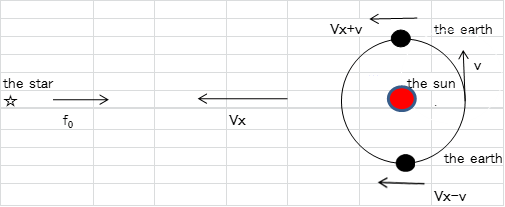
he frequency of the light from the star at space=f0
The speed of the solar system througu space=Vx
The revolution speed of the earth=v
The speed of light=c
The frequency of the light from the star at the earth=f+
when the speed of the earth through space=Vx+v.
The frequency of the light from the star at the earth=f-
when the speed of the earth through space=Vx-v.
f+=f0×(1+(Vx+v)/c)×(1-(1-(Vx+v)^2/c^2)^-0.5
f-=f0×(1+(Vx-v)/c)×(1-(1-(Vx-v)^2/c^2)^-0.5
You can calculate f0 and Vx with these equations.
In addition, if f0s of other stars which are in the direction that the solar system moves are diffrent and Vxs are the same, I think that Vx is the speed of the solar system through space.
9-2. Vx and CBR anistropy
If Vx were the speed of the solar system which move relative to CBR, space would have the black body radiation . And we can not find the difference between CBR and the black body radiation of space.
9-3.Source of black body radiaion and the black body radiation of material on the earth
Source of black body radition has myriad of harmonic oscillator. But material on the earth does not have myriad of harmonic oscilltor. So, source of black body radition of the material on the earth may be the space in the material on the earth. So, black body radition of the material on the earth may have anisotropy which is the same of the anistropy of CBR.
